
Release time :2026-04-01
Source:support@yingchitech.com
Scan:24
Background:
rTMS has demonstrated therapeutic efficacy in various neuropsychiatric disorders. However, previous rTMS studies targeting Autism Spectrum Disorder (ASD) have yielded inconsistent results due to heterogeneity in stimulation protocols and methodological limitations. Additionally, traditional rTMS requires patients to maintain a fixed position for extended periods, which limits its applicability to certain populations. To optimize treatment efficiency, enhance overall efficacy, and broaden the range of suitable patients, a Chinese clinical research team has developed an accelerated continuous theta burst stimulation (a-cTBS) protocol.
This study verified the feasibility, safety, and efficacy of a-cTBS targeting the left primary motor cortex (M1) in improving social communication impairment (SCI) in children with Autism Spectrum Disorder (ASD). The improvement was also associated with enhanced language abilities, suggesting that M1 may serve as a potential therapeutic target for ASD. The findings of this study were published in April 2025 in the journal General Psychiatry (IF = 6.8).
01 Study Method
Subject: Thirty children aged 4–10 years with ASD were enrolled. Changes in social function and language abilities were compared before and after the intervention, as well as at the 1-month follow-up, and were contrasted with a historical control group.
Protocol: YINGCHI M-100 Ultimate TMS device, continuous theta burst stimulation (cTBS), at an intensity of 80% of resting motor threshold (RMT). Each session delivered 1,800 pulses over 120 seconds. Sessions were administered once per hour, with 10 sessions per day (totaling 18,000 pulses daily), for 5 consecutive days (total of 90,000 pulses).
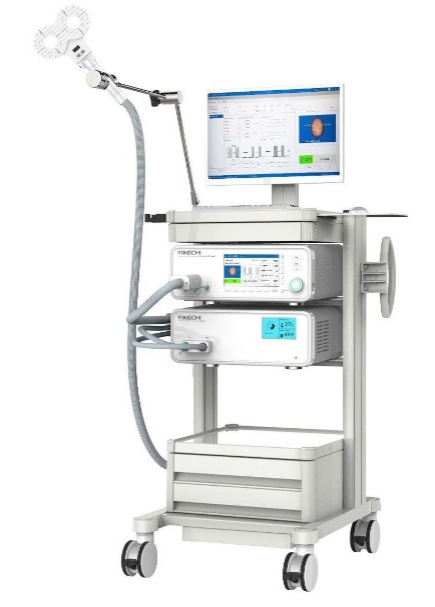
Clinical Assessments: Social Responsiveness Scale (SRS), Clinical Global Impression-Improvement Scale (CGI-I), and language assessment tools (such as PPVT and CCDI).
02 Results
- All 30 children with ASD completed the intervention and follow-up. Mild adverse reactions were reported in 33% of participants (such as agitation and scalp pain), all of which resolved spontaneously, confirming the feasibility and safety of the protocol.
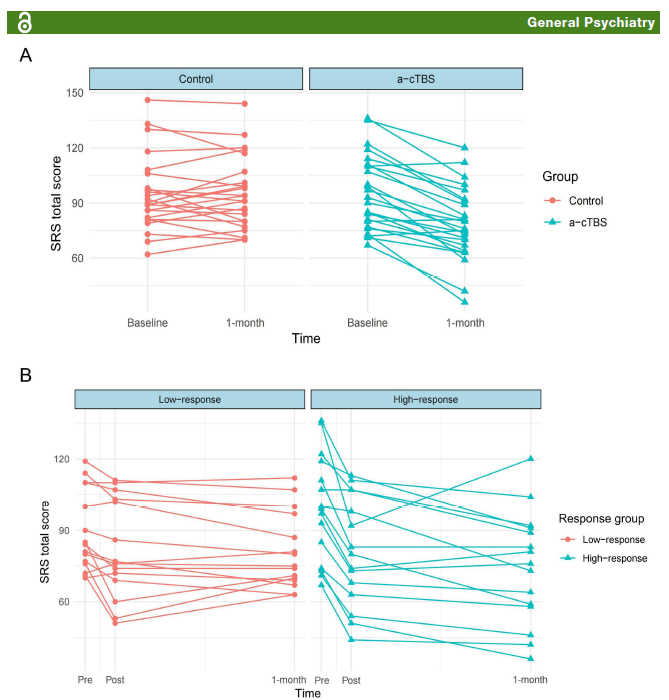
- In the a-cTBS group, the total SRS score decreased from a baseline of 95.76 to 78.52 at the 1-month follow-up (p < 0.001), whereas the historical control group showed no significant change. IPTW analysis indicated that the intervention was associated with a 17.44-point reduction in SRS scores (p < 0.001).
- 57% (17/30) of the children were rated as “much improved” or “minimally improved” on the CGI-I scale. Caregivers reported improvements in social and language abilities.
- In the high-response group (median ΔSRS at 1 month = -14.50), the SRS score showed a significant immediate reduction after intervention (ΔSRS at 5 days = -18.07, p < 0.001). Moreover, the immediate change (ΔSRS at 5 days) was significantly correlated with the 1-month efficacy (r = 0.44, p = 0.014).
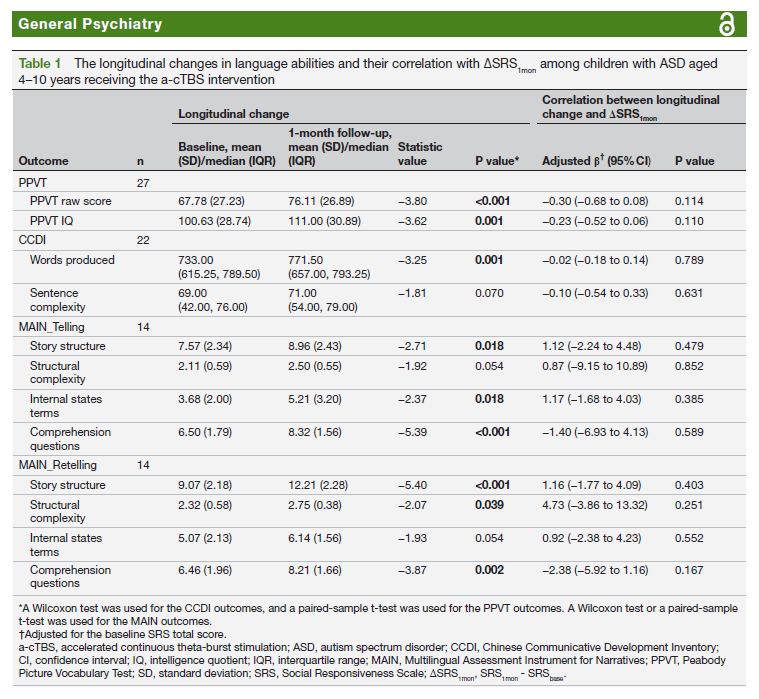
- Language ability assessments revealed significant improvements in PPVT raw scores, IQ, and CCDI vocabulary (all p < 0.001), which were correlated with the trend of SRS improvement.
03 Discussion
a-cTBS enhances neuromodulatory effects through stimulation of the primary motor cortex (M1).
The left primary motor cortex (M1) plays a critical role in action execution, emotional evaluation, and language comprehension. In addition, individuals with ASD exhibit atypical neuroplasticity patterns in response to M1 stimulation, suggesting that M1 may serve as a promising therapeutic target for treating social communication impairment (SCI) in ASD.
Over the past decade, repetitive transcranial magnetic stimulation (rTMS) has been one of the most widely used non-invasive brain stimulation techniques. It has demonstrated efficacy in treating neuropsychiatric disorders such as depression. However, its potential effectiveness in improving social communication impairment (SCI) in individuals with ASD remains limited by considerable heterogeneity and methodological constraints across studies. Continuous theta burst stimulation (cTBS), a novel form of rTMS, achieves comparable or even superior neuromodulatory effects while significantly reducing stimulation duration. By shortening the treatment course to just a few days, it has the potential to improve treatment adherence and overall therapeutic outcomes.
Innovation:
This is the first study to explore M1 as a therapeutic target for ASD intervention. It employs an accelerated cTBS protocol to shorten the treatment cycle, includes young children with intellectual disabilities, and addresses the limitations of previous studies regarding participant selection. Additionally, M1 localization does not require neuronavigation, offering strong clinical practicality.
Limitations:
The open-label design may be susceptible to placebo effects. The study lacked objective tools for assessing social function. The sample size was relatively small, with only 14 participants completing the MAIN language assessment, resulting in limited statistical power. The use of a historical control group may also introduce selection bias.
Research Significance:
This study provides a novel non-invasive intervention for social communication impairment in ASD, particularly suitable for young children or those with intellectual disabilities who have difficulty cooperating with traditional therapies. It offers evidence for the role of M1 in modulating social function and promotes further research into the neural mechanisms of ASD and the development of precision treatments.
04 Conclusion
A 5-day a-cTBS protocol targeting the primary motor cortex (M1) is safe and feasible for children with ASD. It significantly improves social communication deficits, with effects lasting at least one month. The improvement is also associated with enhanced language abilities, suggesting that M1 may serve as a promising potential therapeutic target for ASD.

Statement
This content is organized by the Clinical Support Department of Shenzhen Yingchi Technology Co.,Ltd. Criticisms and corrections are welcome. For reprint, please indicate the source.
Reference:
Tan, H., Xu, M., Ren, T., Deng, L., Zhang, L., Wang, S., … Li, F. (2025). Evaluating the feasibility, safety and efficacy of accelerated continuous theta-burst stimulation targeting the left primary motor cortex to improve social communication impairment in children with autism. General Psychiatry, 38(2), e102012. https://doi.org/10.1136/gpsych-2024-102012